The Importance of Newborn Hearing Screening: A Small Test That Can Change a Lifetime
The first few days of a baby’s life are filled with precious moments, joyful emotions, and important health checks. Among these early assessments, newborn hearing screening plays a vital role in ensuring that a child begins life with the best possible opportunity for speech, language, learning, and social development. Hearing is not just about listening to sounds—it is the foundation for communication, emotional bonding, and cognitive growth.
Many babies with hearing loss appear completely healthy at birth, making it difficult for parents to identify any issue during the early months. This is why newborn hearing screening has become an essential part of neonatal care across the world. With simple and painless tests such as OAE (Otoacoustic Emissions) and ABR (Auditory Brainstem Response), hearing problems can be detected early, allowing timely intervention and support.
What Is Newborn Hearing Screening?
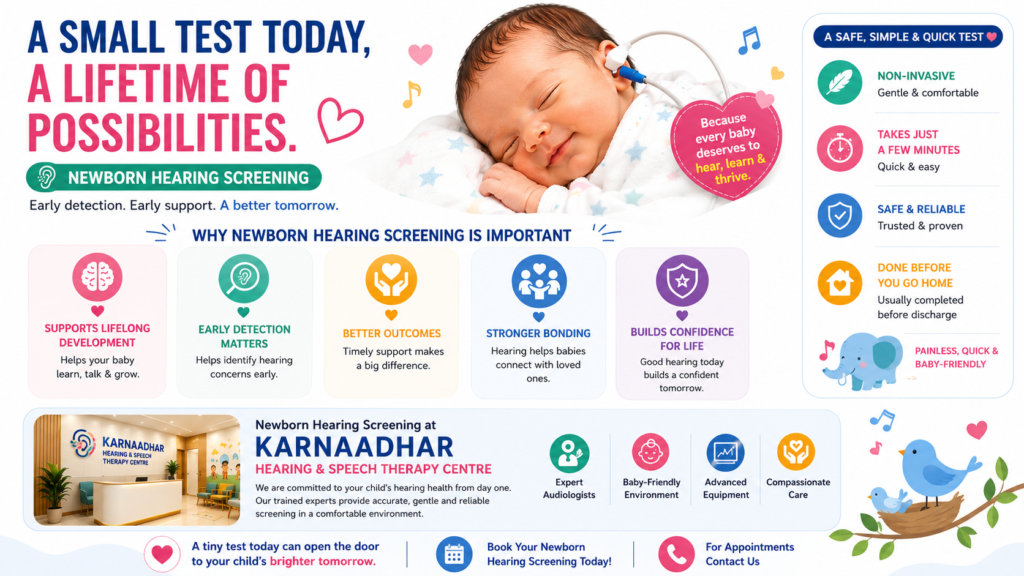
Newborn hearing screening is a quick, safe, and non-invasive test performed shortly after birth to check whether a baby can hear properly. Most hospitals conduct the screening before the baby is discharged, while some clinics may perform it within the first few weeks of life.
The primary goal of newborn hearing screening is early detection. Research has shown that babies who receive early diagnosis and intervention for hearing loss develop significantly better speech, language, and communication skills compared to those diagnosed later.
Since hearing loss is not always visible, screening helps identify concerns that parents or doctors may otherwise miss in the early stages.
Why Is Early Hearing Detection Important?
The first three years of life are critical for brain development, especially for speech and language learning. Babies begin listening and learning from sounds around them almost immediately after birth. They recognize their parents’ voices, respond to environmental sounds, and gradually start understanding language.
If hearing loss goes undetected, it can affect:
- Speech and language development
- Learning abilities
- Communication skills
- Social interaction
- Emotional development
- Academic performance later in life
Early identification allows families to access hearing aids, therapy, cochlear implant evaluations, and speech-language support at the right time. The earlier the intervention, the better the outcome for the child.
What Causes Hearing Loss in Newborns?
Hearing loss in newborns can occur due to several reasons, including:
- Genetic or hereditary factors
- Premature birth
- Low birth weight
- Infections during pregnancy
- NICU stay after birth
- Jaundice requiring treatment
- Certain medications
- Birth complications
In some cases, babies may have hearing loss even without any risk factors or family history. This is another reason why universal newborn hearing screening is so important.
Understanding OAE Screening
One of the most common newborn hearing tests is the OAE screening, which stands for Otoacoustic Emissions.
How Does OAE Work?
During the test, a tiny soft probe is gently placed inside the baby’s ear canal. The probe produces soft clicking sounds, and the inner ear (cochlea) responds by generating echoes. These echoes are measured by the machine.
If the echoes are present, it usually means the inner ear is functioning normally. If no response is detected, further evaluation may be recommended.
Advantages of OAE Screening
- Quick and painless
- Takes only a few minutes
- Can be done while the baby sleeps
- Non-invasive and safe
- Effective for initial hearing screening
OAE screening is widely used because it is simple, comfortable, and reliable for detecting many types of hearing loss.
Understanding ABR Screening
Another important test used in newborn hearing screening is the ABR test, or Auditory Brainstem Response screening.
How Does ABR Work?
In this test, small sensors are placed on the baby’s head and ears. Soft sounds are played through earphones, and the sensors measure how the hearing nerve and brain respond to sound.
Unlike OAE, which checks the inner ear, ABR evaluates the hearing pathway from the ear to the brain.
Advantages of ABR Screening
- Highly accurate
- Detects hearing nerve issues
- Useful for babies in NICU
- Can identify mild to profound hearing loss
- Helps confirm hearing status
ABR screening is often recommended for babies who do not pass the OAE test or who have high-risk medical conditions.
What Happens If a Baby Does Not Pass the Screening?
Parents should remember that not passing the first hearing screening does not automatically mean the baby has permanent hearing loss.
Sometimes the result may be affected by:
- Fluid in the ear after birth
- Baby movement during testing
- Noise in the environment
- Temporary blockage in the ear canal
If a baby does not pass, the doctor or audiologist may recommend:
- Repeat screening
- Diagnostic hearing evaluation
- Follow-up hearing tests
- Monitoring developmental milestones
Timely follow-up is extremely important because delaying assessment may affect early intervention opportunities.
When Should Hearing Screening Be Done?
Experts recommend the “1-3-6 Rule” for newborn hearing care:
- Screening by 1 month of age
- Diagnosis by 3 months of age
- Intervention by 6 months of age
Following this timeline helps children receive the support they need during the most important developmental period.
Signs Parents Should Watch For
Even if a baby passes newborn hearing screening, parents should continue monitoring hearing and speech milestones as the child grows.
Some warning signs include:
- Not responding to loud sounds
- Lack of reaction to parents’ voices
- Delayed speech development
- Not turning toward sounds
- Difficulty understanding speech
If parents notice any concerns, they should consult an audiologist immediately.
The Role of Parents in Early Hearing Care
Parents play a crucial role in supporting their child’s hearing and communication development. Talking, singing, reading stories, and interacting regularly with the baby helps strengthen language learning.
If hearing loss is identified, early support from hearing professionals, speech therapists, and family members can make a remarkable difference in the child’s future.
With advancements in hearing technology and early intervention programs, children with hearing loss today can lead confident, successful, and fulfilling lives.
A Small Test With Lifelong Benefits
Newborn hearing screening may take only a few minutes, but its impact can last a lifetime. Early hearing detection helps babies develop speech, communication, learning, and social skills at the right stage of growth.
Tests like OAE and ABR are safe, painless, and highly effective in identifying hearing concerns early. By acting quickly, families can ensure their child receives the care, therapy, and support needed for a brighter future.
Every baby deserves the chance to hear, learn, communicate, and thrive. A simple hearing screening today can open the door to endless possibilities tomorrow.
For parents seeking professional newborn hearing screening and pediatric audiology services, early consultation with qualified hearing care specialists can make all the difference in ensuring healthy hearing development for your child.