
Hearing Aids Explained: Benefits, Limitations & Expectations
Setting the Right Expectations for Better Hearing and Better Living
Hearing aids are among the most advanced medical devices available today. Modern hearing aids use artificial intelligence, sophisticated sound processing, Bluetooth connectivity, and rechargeable technology to help millions of people hear better and reconnect with the world around them.
Yet, many people still have unrealistic expectations. Some believe hearing aids will restore hearing to normal, while others dismiss them entirely after hearing negative experiences from friends or family.
The truth lies somewhere in between.
Hearing aids are incredibly powerful tools—but they are not a cure for hearing loss. Understanding what they can and cannot do is the key to getting the maximum benefit from them.
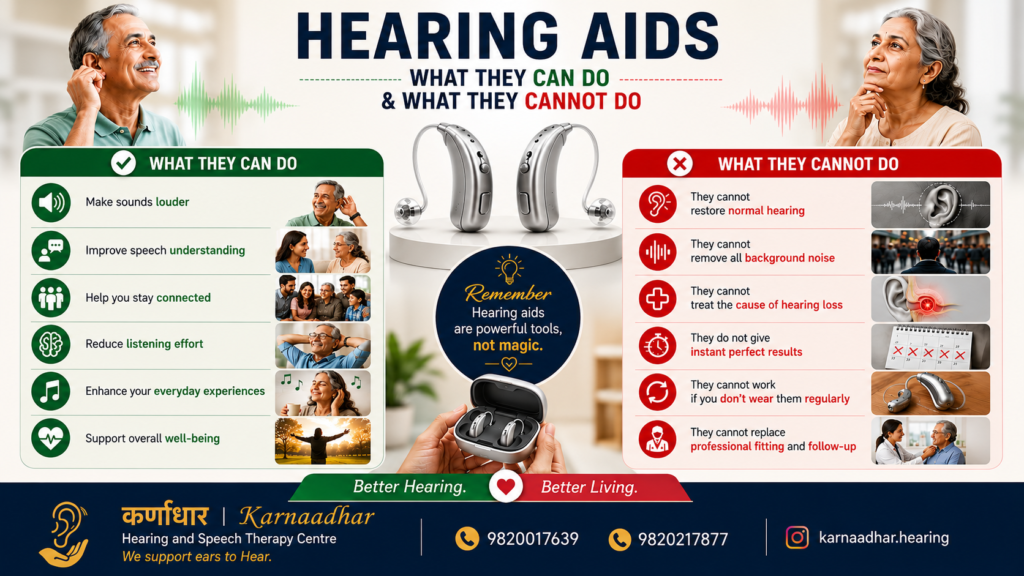
Hearing Aids Explained: What Hearing Aids Can Do
1. Amplify Sounds You Have Been Missing
The primary role of a hearing aid is to make sounds audible again.
Whether it’s the chirping of birds, the ringing of a doorbell, or your grandchild’s laughter, hearing aids amplify sounds according to your individual hearing loss.
Unlike simple amplifiers, today’s digital hearing aids selectively amplify the sounds you need while minimizing unnecessary noise.
2. Improve Speech Understanding
One of the biggest complaints among people with hearing loss is:
“I can hear people talking, but I can’t understand what they’re are saying.”
Modern hearing aids are specifically designed to improve speech clarity.
Advanced microphones and digital processing help emphasize speech, making conversations easier in quiet environments and significantly improving communication in many everyday situations.
3. Reduce Listening Effort
Living with hearing loss is mentally exhausting.
Your brain has to work much harder to fill in missing words during conversations, leading to fatigue by the end of the day.
Properly fitted hearing aids reduce this listening effort, allowing you to participate in conversations more comfortably and naturally.
Many users report feeling less tired and more engaged after wearing hearing aids consistently.
4. Help You Stay Connected
Hearing loss doesn’t only affect your ears—it affects relationships.
Many people gradually withdraw from family gatherings, social events, religious functions, and community activities because conversations become too difficult.
Hearing aids help reconnect people with their loved ones, improving communication and confidence in everyday life.
5. Improve Quality of Life
Research has consistently shown that treating hearing loss improves overall well-being.
People who use hearing aids often experience:
- Greater independence
- Improved confidence
- Better emotional health
- Increased participation in social activities
- Improved workplace communication
Better hearing often leads to a better quality of life.
6. Connect to Your Digital World
Today’s hearing aids are much smarter than most people realize. Hearing Care: Breakthrough Audiology Advancements in 2026
Many modern devices can connect directly to:
- Smartphones
- Television
- Tablets
- Video calls
- Music streaming
- Phone calls
Some models even allow adjustments through a mobile app without visiting the clinic.
What Hearing Aids Cannot Do
Understanding these limitations helps create realistic expectations and greater satisfaction.
1. They Cannot Restore Normal Hearing
Perhaps the biggest misconception is that hearing aids “bring hearing back.”
They do not.
Hearing aids compensate for hearing loss by making sounds more audible, but they cannot repair damaged hearing cells or restore natural hearing.
Think of them like prescription glasses.
Glasses improve vision but do not cure poor eyesight.
The same principle applies to hearing aids.
2. They Cannot Remove All Background Noise
Many first-time users expect complete silence in noisy places.
Unfortunately, that’s not how hearing works.
Even people with perfectly normal hearing struggle to hear conversations in crowded restaurants or busy markets.
Modern hearing aids reduce background noise remarkably well, but they cannot eliminate every unwanted sound.
The goal is better hearing—not perfect hearing.
3. They Cannot Cure Hearing Loss
Hearing aids manage hearing loss.
They do not treat its underlying cause.
If hearing loss results from damage to the inner ear, hearing aids help compensate for that damage but cannot reverse it.
Medical treatment may be necessary for certain types of hearing loss, while others require lifelong hearing rehabilitation.
4. They Do Not Work Instantly
Many people wear hearing aids for a few hours and expect immediate perfection.
Your brain needs time to relearn sounds it may not have heard for months—or even years.
Initially, everyday sounds such as footsteps, fans, running water, or paper rustling may seem unusually loud.
This adjustment period is completely normal.
Most people adapt over several weeks with regular use.
5. They Cannot Help If You Don’t Wear Them
Buying hearing aids is only the first step.
To experience real improvement, they need to be worn consistently.
Occasional use prevents your brain from adapting to amplified sound.
The more consistently you wear your hearing aids, the more natural listening becomes.
6. They Cannot Replace Professional Care
Even the world’s most advanced hearing aid cannot perform well if it is poorly programmed.
Professional hearing assessment, accurate fitting, verification, counselling, and regular follow-up appointments are essential.
Fine-tuning the hearing aids according to your lifestyle makes a significant difference in your hearing experience.
Why Expectations Matter
Studies show that hearing aid satisfaction depends as much on expectations as on technology.
People who understand what hearing aids can realistically achieve are more likely to:
- Wear them regularly
- Adapt faster
- Enjoy better communication
- Feel satisfied with their investment
On the other hand, unrealistic expectations often lead to disappointment—even when the hearing aids are functioning perfectly.
Choosing the Right Hearing Aid Matters
No single hearing aid is ideal for everyone.
The right hearing aid depends on:
- Degree of hearing loss
- Lifestyle
- Work environment
- Cosmetic preferences
- Dexterity
- Budget
- Communication needs
This is why professional guidance is so important.
An experienced audiologist will recommend the most suitable technology based on your individual needs rather than simply suggesting the most expensive device.
Final Thoughts
Hearing aids are one of the most effective solutions for managing hearing loss, but they work best when combined with realistic expectations, consistent use, and professional support.
They may not restore perfect hearing, but they can restore something even more valuable—the ability to reconnect with conversations, relationships, and life’s precious moments.
If you or a loved one has been struggling to hear, don’t wait.
The sooner hearing loss is addressed, the sooner you can begin enjoying clearer conversations and a richer quality of life.
bonus read : Ultimate myths about hearing loss and hearing aids
Why Choose Karnaadhar Hearing and Speech Therapy Centre?
At Karnaadhar Hearing and Speech Therapy Centre, we believe that successful hearing aid use goes far beyond simply fitting a device. We provide comprehensive hearing evaluations, personalized hearing aid selection, precise programming, counselling, and ongoing follow-up care to ensure you receive the maximum benefit from your hearing aids. Services – karnaadhar
📞 Call us today: 9820017639 | 9820217877
Better Hearing. Better Living.